Analogs of Future Climate in Chinese Cities Identified in Present Observations
Dec 4, 2020· ,,·
0 min read
,,·
0 min read
Cong Yin
Fei Yang
Juanle Wang
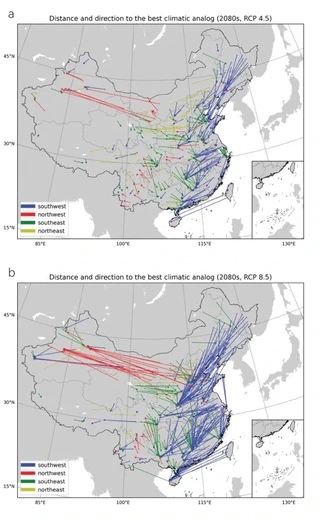 Distance and direction to the best climatic analog under (a) RCP4.5 and (b) RCP8.5 in the 2080s.
Abstract
There seems to be a gap between the public and complex climate prediction models that reduces public awareness of and participation in climate change research. Therefore, it is necessary to describe the trends of future climate change with more concise conclusions. Climatic analogs are an effective method used to measure the similarity between two climate scenarios. By mapping a given climate scenario to another, familiar climate scenario and measuring their similarity, complex climate prediction models can be simplified and made easier to understand. In this study, we used climatic analogs of 378 cities in China and the suitable future climate area of China to study climatic novelty in China. The results show that (1) climatic novelty in the North China Plain, Xinjiang, Tibet, and parts of southern China is relatively high, and these areas may experience more drastic climate changes than other areas; (2) most cities have climatic analogs to the south, hundreds of kilometers away, indicating that the climates of these cities may change significantly; and (3) China’s suitable climate area will change significantly in the future, and these changes are closely related to whether effective emission reduction measures are taken. The results of this study have repeatedly proven the need for effective emission reduction measures that will significantly delay climate change.
Type
Publication
IEEE Access

Authors
Cong Yin
(殷聪)
Postdoc Scientist
I am an early-career climate scientist pushing the boundaries of understanding wildfires and climate extremes using hydroclimatic, data-driven, and geostatistical approaches. My work has led to step-changes in understanding the synchronicity and persistence of extreme fire weather, factors that strongly influence extreme fires.
I work with Prof. John Abatzoglou, who leads the Climatology Lab at University of California, Merced.
Authors
Authors