Heatwaves enable wildfire activity in the western United States
Jun 19, 2026·, ,,,,·
0 min read
,,,,·
0 min read
Dmitri A. Kalashnikov
John T. Abatzoglou
Cong Yin
Madhulika Gurazada
Mukesh Kumar
Ashwin P. Thomas
Precious E. Ebiendele
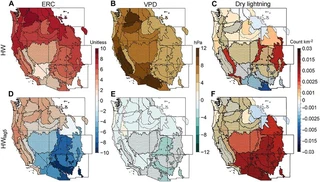 Differences in meteorological variables compared to days preceding heatwaves
Abstract
While overall impacts of heatwaves have been extensively studied, the connection between heatwaves and wildfire activity remains relatively underexplored. We analyze links between heatwaves and both wildfire occurrence and growth across the western United States (WUS) and find that 42% of burned area during 2001–2024 occurred during and immediately following heatwaves. Heatwaves facilitate significant increases in daily burned area through meteorological and fuel flammability conditions that promote new ignitions and exacerbate ongoing fire activity, with effects persisting post-heatwave in most regions. In addition, heatwaves co-occur with increased cloud-to-ground lightning that can potentially increase ignitions. Last, we observe a 2.5-fold increase in burned area in WUS forests since 2001, with ~64% of this increase coinciding with heatwaves, but without corresponding increases in nonforests. The growing influence of heatwaves in shaping burned area in WUS forests has important implications for fire management and public health and can improve predictions of wildfire risk. Heatwaves are associated with a disproportionate share of wildfire activity and trends in the western US in recent decades.
Type
Publication
Science Advances

Authors
Cong Yin
(殷聪)
Postdoc Scientist
I am an early-career climate scientist pushing the boundaries of understanding wildfires and climate extremes using hydroclimatic, data-driven, and geostatistical approaches. My work has led to step-changes in understanding the synchronicity and persistence of extreme fire weather, factors that strongly influence extreme fire activity. My recent research focuses on extreme fires, one of the most societally and environmentally destructive consequences of climate change.
I work with Prof. John Abatzoglou, who leads the Climatology Lab at University of California, Merced.