Fire weather waves drive extreme fires globally | Communications Earth & Environment
Jul 23, 2026· ,,,,,·
0 min read
,,,,,·
0 min read
Cong Yin
John T. Abatzoglou
Piyush Jain
Mojtaba Sadegh
Mike D. Flannigan
Matthew W. Jones
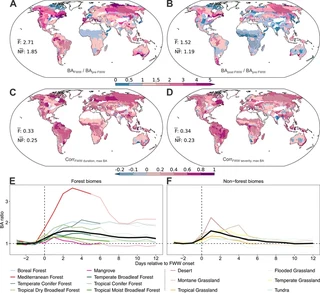 FWWs promote burning by sustaining fire-conducive weather conditions
Abstract
We define fire weather waves as persistent extreme fire weather, which can intensify fire activity by sustaining exceptionally warm, dry, and windy conditions. Here, we use daily fire weather index, fire activity, and meteorological data to examine the impacts of fire weather waves on fires, as well as their patterns and trends across global terrestrial ecoregions. Fire weather waves account for only 4% of days but coincide with 26% of the area burned and nearly half of the top 1% most energetic fires in forested ecoregions. Compared with grassland and shrubland fires, forest fires exhibit a larger and more persistent increase in daily burned area in response to fire weather waves, particularly in Mediterranean forests. Fire weather wave frequency has significantly increased across most burnable lands during 1979–2024. Climate projections indicate that fire weather waves will increase throughout the 21st century. These findings underscore fire weather waves as an essential component of early warning systems to strengthen preparedness for extreme fires.
Type

Authors
Cong Yin
(殷聪)
Postdoc Scientist
I am an early-career climate scientist pushing the boundaries of understanding wildfires and climate extremes using hydroclimatic, data-driven, and geostatistical approaches. My work has led to step-changes in understanding the synchronicity and persistence of extreme fire weather, factors that strongly influence extreme fire activity. My recent research focuses on extreme fires, one of the most societally and environmentally destructive consequences of climate change.
I work with Prof. John Abatzoglou, who leads the Climatology Lab at University of California, Merced.