Wildfire
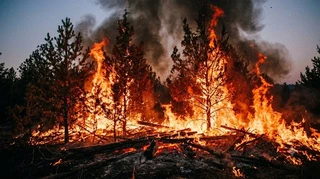
Wildfires represent one of the most destructive feedback loops within the Earth’s coupled terrestrial-climate system. This research focuses on the spatiotemporal evolution of extreme fire weather conditions and their underlying coupling mechanisms with broader climate system anomalies:
🌐 Spatial Synchronicity of Extreme Fire Weather
Pioneering the quantification and identification of an intensifying global spatial “synchronicity” in severe and extreme fire weather. This critical finding holds profound strategic implications for the international coordination of firefighting resources and the cross-regional risk management of energetically extreme fires.
📚 Related Publications:
🏜️ Compound Climate Drivers of Extreme Wildfires
Conducting a comprehensive analysis of how antecedent and concurrent meteorological anomalies facilitate energetically extreme fire behavior. In particular, this work systematically elucidates the catalytic mechanisms by which extreme heatwaves and persistent fire weather extremes drive fire activity across high-risk regions, thereby advancing the mechanistic understanding of the compound “heat-drought-fire” disaster cascade. Recent work further introduces the concept of fire weather waves—persistent periods of extreme fire weather—and demonstrates their disproportionate contribution to global extreme fires, providing a new framework for understanding and forecasting wildfire extremes.
📚 Related Publications:

I am an early-career climate scientist pushing the boundaries of understanding wildfires and climate extremes using hydroclimatic, data-driven, and geostatistical approaches. My work has led to step-changes in understanding the synchronicity and persistence of extreme fire weather, factors that strongly influence extreme fire activity. My recent research focuses on extreme fires, one of the most societally and environmentally destructive consequences of climate change.
I work with Prof. John Abatzoglou, who leads the Climatology Lab at University of California, Merced.