Strengthening Fire Preparedness and Coordination: Quantifying the Persistence and Synchronicity of Extreme Fire Weather
2025年11月10日· ,·
0 分钟阅读时长
,·
0 分钟阅读时长
殷聪
John Abatzoglou
 报告海报
报告海报摘要
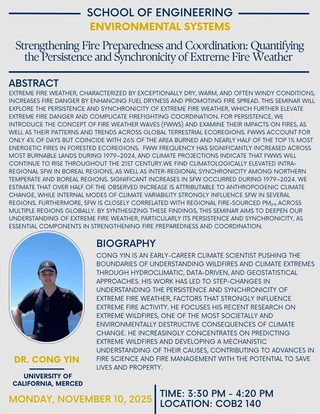
Extreme fire weather, characterized by exceptionally dry, warm, and often windy conditions, increases fire danger by enhancing fuel dryness and promoting fire spread. This seminar will explore the persistence and synchronicity of extreme fire weather, which further elevate extreme fire danger and complicate firefighting coordination. For persistence, we introduce the concept of fire weather waves (FWWs) and examine their impacts on fires, as well as their patterns and trends across global terrestrial ecoregions. FWWs account for only 4% of days but coincide with 26% of the area burned and nearly half of the top 1% most energetic fires in forested ecoregions. Compared with grassland and shrubland fires, forest fires exhibit a larger and more persistent increase in daily burned area in response to FWWs, particularly in Mediterranean forests. FWW frequency has significantly increased across most burnable lands during 1979–2024, and climate projections indicate that FWWs will continue to rise throughout the 21st century. For synchronicity, we examine the patterns and trends of intra- and inter-regional synchronous fire weather (SFW) and explore their links to climate variability and air quality impacts. We find climatologically elevated intra-regional SFW in boreal regions, as well as inter-regional synchronicity among northern temperate and boreal regions. Significant increases in SFW occurred during 1979–2024. We estimate that over half of the observed increase is attributable to anthropogenic climate change, while internal modes of climate variability strongly influence SFW in several regions. Furthermore, SFW is closely correlated with regional fire-sourced PM₂.₅ across multiple regions globally. By synthesizing these findings, this seminar aims to deepen our understanding of extreme fire weather, particularly its persistence and synchronicity, as essential components in strengthening fire preparedness and coordination.
位置
COB2 140
5200 North Lake Rd., Merced, CA 95343

Authors
殷聪
(Cong Yin)
博士后
我专注于气候科学领域,致力于使用水文气候、数据驱动和空间统计方法,增进对野火和极端气候事件的理解。我在揭示极端火灾天气的同步性和持续性方面取得了进展,这些因素对极端火灾具有重要影响。
我目前在加州大学Merced分校做博士后,与John Abatzoglou教授合作,他领导着Climatology Lab。
Authors