Spatiotemporal Distribution and Risk Assessment of Heat Waves Based on Apparent Temperature in the One Belt and One Road Region
2020年4月6日· ,,,·
0 分钟阅读时长
,,,·
0 分钟阅读时长
殷聪
Fei Yang
Juanle Wang
Yexing Ye
 Heat wave risk assessment
摘要
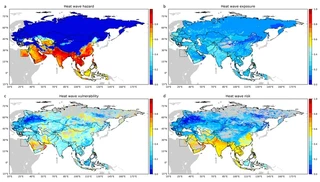
Heat waves seriously affect the productivity and daily life of human beings. Therefore, they bring great risks and uncertainties for the further development of countries in the One Belt and One Road (OBOR) region. In this study, we used daily meteorological monitoring data to calculate the daily apparent temperature and annual heat wave dataset for 1989–2018 in the OBOR region. Then, we studied their spatiotemporal distribution patterns. Additionally, multi-source data were used to assess heat wave risk in the OBOR region. The main results are as follows: (1) The daily apparent temperature dataset and annual heat wave dataset for 1989–2018 in the OBOR region at 0.1° × 0.1° gridded resolution were calculated. China, South Asia and Southeast Asia are suffering the most serious heat waves in the OBOR region, with an average of more than six heat waves, lasting for more than 60 days and the extreme apparent temperature has reached over 40 °C. Additionally, the frequency, duration and intensity of heat waves have been confirmed to increase continuously. (2) The heat wave risk in the OBOR region was assessed. Results show that the high heat wave risk areas are distributed in eastern China, northern South Asia and some cities. The main conclusion is that the heat wave risk in most areas along the OBOR route is relatively high. In the process of deepening the development of countries in the OBOR region, heat wave risk should be fully considered.
类型
出版物
Remote Sensing

Authors
殷聪
(Cong Yin)
博士后
我专注于气候科学领域,致力于使用水文气候、数据驱动和空间统计方法,增进对野火和极端气候事件的理解。我在揭示极端火灾天气的同步性和持续性方面取得了进展,这些因素对极端火灾具有重要影响。
我目前在加州大学Merced分校做博士后,与John Abatzoglou教授合作,他领导着Climatology Lab。
Authors
Authors
Authors