Increasing synchronicity of global extreme fire weather
2026年2月18日· ,,,,,,·
0 分钟阅读时长
,,,,,,·
0 分钟阅读时长
殷聪
John T. Abatzoglou
Matthew W. Jones
Alison C. Cullen
Mojtaba Sadegh
Juanle Wang
Yangxiaoyue Liu
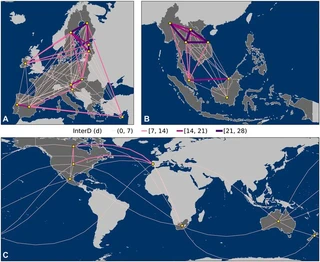 年平均国家间SFW日
摘要
Concurrent extreme fire weather creates favorable conditions for widespread large fires, which can complicate the coordination of fire suppression resources and degrade regional air quality. Here, we examine the patterns and trends of intra- and interregional synchronous fire weather (SFW) and explore their links to climate variability and air quality impacts. We find climatologically elevated intraregional SFW in boreal regions, as well as interregional synchronicity among northern temperate and boreal regions. Significant increases in SFW occurred during 1979 to 2024, with more than a twofold increase observed in most regions. We estimate that over half of the observed increase is attributable to anthropogenic climate change. Internal modes of climate variability strongly influence SFW in several regions, including Equatorial Asia, which experiences 43 additional intraregional SFW days during El Niño years. Furthermore, SFW is strongly correlated with regional fire-sourced PM2.5 in multiple regions globally. These findings highlight the growing challenges posed by SFW for firefighting coordination and human health. Increasing synchronicity of global extreme fire weather constrains fire suppression coordination and exacerbates air pollution.
类型
出版物
Science Advances

Authors
殷聪
(Cong Yin)
博士后
我专注于气候科学领域,致力于使用水文气候、数据驱动和空间统计方法,增进对野火和极端气候事件的理解。我在揭示极端火灾天气的同步性和持续性方面取得了进展,这些因素对极端火灾具有重要影响。
我目前在加州大学Merced分校做博士后,与John Abatzoglou教授合作,他领导着Climatology Lab。
Authors
Authors
Authors
Authors
Authors
Authors